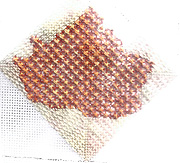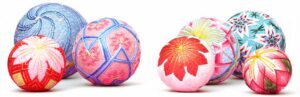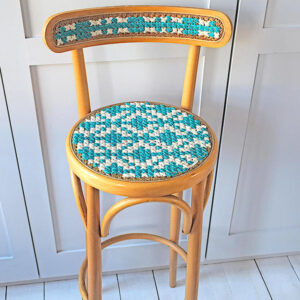
Originally posted 2010-09-02 07:03:00. Republished by Blog Post PromoterI finally got around to counting up the votes for this (I’m a charter member of the procrastinator’s club) and the winner for a club theme for next year is stitches and quilt blocks. I’m excited because quilts always inspire me and this is such a wonderful way to learn new stitches. Best of all, with mostly square sides or true diagonals, compensation is really easy. It will also give us a wonderful way to explore colors through the projects. I’m going off to do some hard-core designing. And I also need to know your opinion for how you would like to see these packaged. There are three options, which I’ll list from most to least expensive. painted canvas – you will get a painted canvas in a specific color scheme. The lesson will tell you exactly the threads/colors to buy line-drawn
designing Archive
If you missed the chance to take my popular Planning the Perfect Needlepoint Canvas class in November when it was offered, you can now take the class as a Needlepoint Independent Study. This class gives you the insights and tools you need to: recognize your stitching level (it’s more than the stitches you know) recognize the complexity of a canvas pick the perfect canvas for you plan threads and stitches to get the results you want Whether this is your first canvas or your 500th, whether it’s a kit from the craft store or a hand-painted canvas, you’ll learn so much in this class that your needlepoint will be energized and improved — all without needing to commit to stitching a class project. Sign up for this Needlepoint Independent Study Course on this page today and improve your stitching
Originally posted 2010-12-21 06:58:52. Republished by Blog Post PromoterThe chances are good that you have your gift shopping finished, but in case you have procrastinated I’d like to suggest some charming sources of needlepoint inspiration you might consider. I found this sleeping cat calendar at Paper Source. Last week I found a bunch more of other animals at a shop in Japantown in San Francisco. It is also available at Urban Outfitters. Made by Greeting Life, a Japanese company, these calendars feature simple outlines and heavy paper. I love this little cat and am planning some kitty needlepoints. I’m taking one card, copying and enlarging it and will use it as a line drawing for making some needlepoint. Buy one of these calendars for someone and not only do they have a practical gift but the start of some great needlepoint. Coloring books, if they aren’t too detailed also make
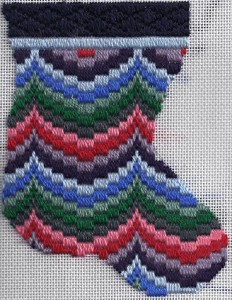
Originally posted 2010-12-24 07:06:18. Republished by Blog Post PromoterThe wonderful stitcher, Needleartnut, has a charming little Bargello mini-sock on her blog. It was a UFO which she just finished. It’s one of my favorite kinds of Bargellos. She uses a simple ribbon pattern and stitches it in several different fibers. I often do this using, as she did, an overdye as the theme for the colors. It’s a simply fantastic way to do a no stress needlepoint project between more challenging pieces. Pull out the threads, trace the outline on your canvas, stitch the first line and then just needlepoint. Check it out, it’s lovely
For all these years I’ve been doing needlepoint, I’ve always seen things that inspire me: great ideas, lovely needlepoint, cool techniques. And until recently I’ve kept these by making notebooks, lots and lots of notebooks. But there are several problems with them. They are not organized take up too much space new ones can be hard to find Pinterest acts as a wonderful virtual and organized notebook. I’m crazy about the site and I’m using it as a collected repository of needlepoint. On Pinterest, images are collected into boards that are of a subject. Because you determine the names of the boards, you can categorize them however you like. For example, I have a board called “cats” but another pinner (the term for users) has boards for tabby cats, white cats, black cats, and kittens. Most of my boards have to do with needlepoint and I’d like to share them
Winter is a lovely time to stitch and so I’m announcing an easy stitch along that will run monthly through the end of 2013. It’s a monthly color challenge and there will be two sources of inspiration. Pick one, do both, improvise on them — whatever. The choice will be up to you. You don’t even need to use all the colors, maybe one will be perfect for a project in progress. You just need to stitch something based on one of the inspiration colors. That’s it. If you like you can send me a picture of what you stitched, I’ll add it to that month’s color challenge gallery. The first basis for the challenge is a skein of multi-colored thread. This month’s is Illawong, a very warming combination, from Dinky Dyes. It’s pictured above. The second basis is a color scheme from my favorite color blog, Design Seeds. In
Do you like Tiffany glass? A major collection of Tiffany had been collected by one man and housed in a specially-built museum in Japan. With the earthquake and tsunmai, he decided this wasn’t the best place for such and extensive collection, so he decided to auction it off earlier this year. The auctioneer was in Alameda CA not far from me. On Saturday morning my son and I travelled to see the preview. It was amazing — stuff Louis Comfort Tiffany owned, plates, windows, lamps, vases, desk sets, and tons of other stuff. The auction is over but you can still enjoy the catalog as a PDF (it has every piece pictured), see highlights on-line, or even buy a printed version ($45 shipped) if you call. In the highlights click on a thumbnail to see a larger picture. Lamps were a big part of the auction and each had it’s
Originally posted 2009-10-24 07:41:47. Republished by Blog Post Promoter Talk about cross pollination, the idea for CyberPointers new book (now available to order as a download or CD) was to make needlepoint ornaments inspired by classic quilt blocks. This needlepoint quilt block inspired a quilt! Peg Dunayer designed this block. In the instructions she says “This pattern is a representation of the quilt pattern, Log Cabin. By using the same thread for the entire piece, an amazing effect is achieved: the overall appearance is that of a randomly pieced scrap quilt.” Her version of the block is pictured above. I stitched the second model of the block, using a different color of Watercolours and found the same thing. My version is pictured above. The interaction of the colors is both unplanned and very exciting. Peg thought so too and decided to make a quilt inspired by her needlepoint. She says
Lois Kershner, self-published, 2012 ISBN978-1-4675-1069-1 Lois’s threadscape needlepoints are so wonderfully compelling: take a stunning landscape and use it as the basis of needlepoint. Others have created needlepoint postcards in the past, but Lois’s pieces not only depict the scene, they make it better. Visit her website and see some she offers as classes and you’ll immediately see what I mean. Better than taking a class to do one of these projects, though wonderful in itself, is learning how to do your own version of these lovely threadscapes. This new book is designed both to give you the tools and techniques you need to stitch a threadscape, and to give you the confidence to do one on your own. In this Lois succeeds admirably. The book is divided into three sections. The first chapter handles design considerations in creating a threadscape. I like that it applies many tried and true
Originally posted 2010-07-02 07:34:43. Republished by Blog Post Promoter Renaissance Dyeing makes a lovely line of crewel-weight wool. It’s very soft and is naturally dyed. Those of your who know something about dying will know that bright modern colors are not something you expect from fibers dyed with plant and animal material. Those bright colors are something we associate with the chemical dyes around for about 150 years. I always thought of Renaissance’spalette as muted, but simply lovely. So imagine my surprise when my friend Karen Milano owner of The Nimble Needle in New Jersey created this bright palette using these threads for a client. It surprised her, but they are just perfect. Read all about it in this post
Originally posted 2007-10-24 07:33:47. Republished by Blog Post PromoterKnitting holds a deep fascination for me. This could be because mygrandmother was a phenominal knitter (American style) while, being left-handed, I cvoujldn’t figure it out. Once I did and started knitting I found out I wasn’t good at it. But that doesn’t stop me from loving the patterns of knitting. I do, And often I use them in my needlepoint. Patterned stitches, knitted in plain knitting from charts, often translate really well to needlepoint. One not however, use geometric, stripes, and abstract patterns onle, don’t do letters or large objects. Why? Needlepoint stitches are square, knitting stitches are rectangular. If something looks “correct” in a knitting stitch, it will be distorted in needlepoint. Try it with a letter — you’ll see what I mean. One great way to start is to look at books of Fair Isle knitting patterns. These charming
Originally posted 2009-11-17 06:59:08. Republished by Blog Post Promoter Colonial houses, especially the ones of Colonial Williamsburg, are one of my favorite things. I grew up in a neo-colonial house (it looked like Mt. Vernon). I loved Williamsburg when I went there when I was 10. One of the things I love about Annapolis is all the charming colonial houses. I’ve been asked recently about needlepointing houses, which poses some interesting problems. As a result I’m putting together a free project on stitching houses, our new Come Stitch with Me project. Our project will have four houses on it, all colonials. One will be brick, one stone, and two wood. hey can be stitched as a set or individually as ornaments. We’ll got through the process together, talking about threads, stitches, and techniques for stitching windows, paths, grass, and roofs. We’ll even spend a little bit of time “decorating” the
CRESUS artisanat is not likely to be a name you’ve heard before. But this delightful Etsy shop is owned by Haruhi, a Japanese stitcher who makes delightfully original needlepoint. Her paisley needlepoint coasters are pictured here. She also has a lovely blog with pictures of many of her projects. Although it’s in Japanese, you’ll love the close-up pictures of her work. I also like that there is so much here that we can apply to our own work. Single & Simple – Notice that each piece only uses one stitch and often it is a simple one. As we progress in stitching we often forget just how powerful the most basic of stitches can be. Stick to one type of color – The coasters pictured here use a mostly neutral palette with lots of whites. Other pieces of hers use brights with white. She uses a polychrome (many-colored) scheme but
Daniel Sheets Dye, Dover, 1974 Of all the books I own which I use for designing, this is my all-time favorite. I’ve had it for 30 years and have paged through it many times looking for ideas for patterns and stitches. The book is a collection of well over a thousand different lattice designs created in China between 1000 and 1900. Most of these designs have been used for windows, screens and other decorative devices throughout China. Dye traveled around China, sketching these designs which he later classified and collected in this book. (There is also a second, much shorter, book of designs, but this one is best.) Chinese Lattice Designs has a relatively short introductory section which covers the way the designs were collected, the construction techniques, the classification system and the history of lattice. While these are not essential to the dneedlepointer’s purpose, they make for fascinating reading.
Originally posted 2009-04-11 06:27:49. Republished by Blog Post PromoterI found a lovely site devoted to the art of stitching in silk during the Middle Ages. The name of the site is Medieval Silkwork and I wanted to share with you some of the treasures I’ve found. Silkwork Pattern – You are going to have to translate this lovely wide border to counted work, but it is stunning and available as a PDF. It’s all Straight Stitches, so consider the shortest stitches to go over two threads. The longest go over six threads. An in-depth explanation of the different types of silk threads. This post has close-up pictures and explanations. A lovely purse and a pouch which could be the basis for a charming bit of needlepoint. Remember that back in those days there wasn’t the distinction we have now between needlepoint canvas, evenly woven fabrics, and non-evenly woven fabrics. Many