Originally posted 2008-12-21 15:34:34. Republished by Blog Post Promoter Judy updated her delightful Four Way Bargello I wrote about yesterday with two more posts. On the FREEBIES,Etc. blog there is a post showing the completed border and talking about her plans for the spring versions. I also think she has the best advice ever for doing Four Way Bargello, mark out the diagonals with a pen on your canvas. Turning the pattern on the diagonal and having them line up properly is, I think, the hardest thing about Four Way Bargello, I’ll be starting a new Four Way ornament in a couple of weeks (after I get this pile of deadlines complete and I’m going to do this. Her blog POSSIBILITES, Etc. has a post showing the completed ornament and talking about an alternative for finishing

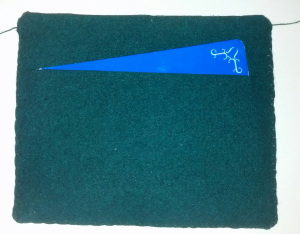
Using Plastic Canvas, felt & a scrap of fabric, you can make the delightful project from my friend Diane over at CraftyPod. It’s a needlebook with a pin cushion on the front cover. It’s so adorable I wish I sewed. Check out the tutorial. Copyright secured by Digiprove © 2013Some Rights ReservedOriginal content here is published under these license terms: X License Type:Non-commercial, Attribution, no Derivative workLicense Summary:You may copy this content, and re-publish it in unmodified form for non-commercial purposes, provided you include an overt attribution to the author(s). You are not permitted to create derivative works.License URL:http://creativecommons.org/licenses/by-nc-nd
When I try many new things in needlepoint I tend to fail, miserably. I’ve tried to learn to paint canvas twice, once from dede Ogden, and failed both times. I made a strong effort to conquer Hilton Stitches, only to discover that they aren’t to my taste. And the there is the whole charted needlepoint thing — I can’t count and so charted pieces are always new horizons in creative interpretation. At the moment though I have three creative goals on my mind. I want to get good at creating stitch diagrams. I do well enough with my cobbled together tools but I’d like them to look better. I want to learn to be more creative. I think I can do this, but I need to set aside time for it. I want to explore new ways to get designs on canvas and creating non-stitched backgrounds. I have slews of
Originally posted 2011-04-22 07:39:26. Republished by Blog Post Promoter Needle Nook of La Jolla is creating a video library for needlepoint and the first entry is fantastic. David McCaskill shows how to use a laying tool. If you’ve never had a chance to see David in person watch this to get a look at his delightful personality. I learned to use a laying from David many years ago when he lived in northern California, so I highly recommend this
School’s out, vacation and pool time is here, but you want to needlepoint. All your projects are big, too big to stash easily in your beach bag, tote, or carry on. What’s a stitcher to do? There are two keys to portable needlepoint — size and sturdiness. Pick Sturdy Threads Let’s talk sturdiness first. You need projects that have single-strand colorfast threads. You don’t want to ply in the wind at the beach or on a crowded plane. You don’t want a drop of water to destroy your piece. Look to Miniaturize your Tools Smaller is better when traveling. That means find smaller and slimmer versions of your tools. Do you like a laying tool? Look for shorter ones. I’ve seen short BLTs, short wooden laying tools, and short metal ones with fat acrylic handles. Do you normally use 4″ scissors? Look for inexpensive 3″ ones. I use titanium ones
Today’s Craft in June post is supposed to be about our favorite medium. Since that’s needlepoint for me (no duh), I thought I’d talk about canvas. One big thing that has changed about needlepoint is our perception of what’s “normal” in canvas. Throughout the 70′s and into the 80′s 10 and 12 mesh was thought of as normal. 18 mesh was considered petitepoint. Honest to God, you can look it up. By the mid 80′s this was changing and 18 mesh became common, then it became the normal canvas mesh. What does this mean to you as a stitcher. When larger meshes were most popular needlepoint was done mainly with Persian wool. This wool had uneven plies so a single strand would not work on 18 mesh. Along with the popularity of 18 mesh came an explosion of threads made to work on this mesh. Today 13 mesh is becoming
Originally posted 2008-12-18 06:58:58. Republished by Blog Post Promoter I know, you aren’t like me, you don’t have boxes of stitched but unfinished needlepoint sitting around your house. You’re good, and every piece you stitch immediately gets finished into something. Yeah. Right. And I bet you never thought that one piece which languishes this way could never become the start of a gift so lovely, you’ll wonder why you didn’t do this before. Just about any needlepoint which is blocked so it’s square can quickly be made into an adorable tote bag with nothing more than a glue gun. So now instead of stitching and finishing something, you can buy a ready-made tote bag at a local shop, invest in a glue gun (if you don’t have one) and make a gift. Here’s what you need: stitched and blocked square or rectangular needlepoint with 1″ canvas margins low-temp glue gun

Instead of buying one of these cases, why not make your own? Begin by getting a Stitch & Zip glasses case with a blank front. That way you can finish it yourself quickly. Next do a Google image search for sunglasses outline. I did that and found lots of cool shapes. Find one you are seeing from the front and save it to your computer. Before tracing it onto the canvas, you may need to enlarge it. Once it’s the right size, upzip the case and put the outline under the bare canvas. Using a Pigma Micron pen trace the glasses frame onto the canvas. When you do this don’t forget to trace the inside of the frame so you have a place for the lens. Using Tent Stitch and your choice of threads (the original is in wool) but I’d do a mix of threads myself, stitch the glasses.
I’m not a one for spending huge amounts on my stitching. Partly it’s that I like small projects. But partly it’s that I’m inherently cheap. But I did splurge, and hugely, once. It started because my bedroom had high ceilings and nothing hanging on the wall. I’m of the opinion that you can’t have enough art. I was at Needlepoint Inc and saw a stunning canvas of pomegranates in a wide border by Mika Partridge (many of her canvases are distributed by Julia’s Needleworks these days). I was over $300 in the early 90′s. I got a picture of it and showed it to my husband. I told him the price and said the threads would cost almost as much. I love what he said. He told me that we would pay that much for a painting and that this was art, not just needlepoint. So it was worth it.
Originally posted 2011-03-18 07:48:36. Republished by Blog Post Promoter This week we’ll list the open stitches and techniques from the Stitches for Effect books. Each is listed by its name. After the name you’ll find the volume and page number. This concludes the series of indexes for these popular books. Open Stitches are those stitches designed to leave some canvas exposed. Techniques are those stitches or stitch patterns that are for a particular technique such as Bargello, Pattern Darning or Laidwork. I – Stitches for Effect II – More Stitches for Effect III – Even More Stitches for Effect Remember all these stitches are also in their “Just the Facts, Ma’am” book, Stitches to Go. Open Stitches Alicia’s Lace Variation I-22 Sprats Head I-49 Sprats Head Heart I-49 Buttonhole II-35 Open Cretan II-53 T Stitch II-61 Tied Cross with Small St. George’s Fill II-62 Techniques Bargello Line 1 I-23 Bargello
You might think that needlepoint belts are the ultimate preppy accessory, but they can be so much more. Before we get into looking at how to make a needlepoint belt, let’s think about ways you can use them: turn them into a purse, camera or guitar strap cut them up and use them to make a purse or sandals let them decorate the top of a purse finish them to be trim on a basket make them the edge of a tray There’s lots of things you can do with these long skinny canvases. Needlepoint belts are usually about 1.25 inches wide or 21 threads on 18-mesh canvas. That’s the finished length. When stitching you need to add a row of binding stitch, or overlapping cross, on each side. Don’t be tempted to just make Tent Stitch. The overlapping layers of biding stitch help because the edges get the most
Todays request is to have a rant. I’m bothered by what is happening to needlepoint because of a lack of openness and customer service in so many of our shops. From anecdotal evidence I’ve seen: Shops charging to tape the edges of canvases for a customer, which gives them FREE ADVERTISING just because only the threads were bought there. I have a newsflash for you threads don’t have your shop’s name on them, the tape does. Get over that it wasn’t bought there, Take the advertising. Shops not ordering a thread wanted by an existing customer even though the customer has contacted the manufacturer to be sure the thread is there and checking that there is no minimum. And the customer said she’d be willing to pay for the shipping. Talk about low-hanging fruit. This is a sale on a silver platter. If you are a shop don’t EVER pass
Originally posted 2010-02-22 07:39:19. Republished by Blog Post Promoter Stitching a painted canvas looks so easy. The colors are picked out for you and all you need to do is add threads and stitches — so why is it that so often we are not happy with the results? Since I discovered painted canvas (in the early 80′s) I’ve stitched hundreds of them, I even dream about canvases, threads, and stitches. As a result I’ve figured out some guidelines for stitching them which make it easier to do. First, I think about threads. Your canvas gives you color, but not texture. And for any given color a number of threads exist in different textures. For me, I try to pick a thread with a texture similar to what the object is in real life. For example snow, should be a white or clear sparkly thread. My favorite for this (and

With a big TNNA Market later this month, many companies are releasing new products that are perfect for needlepointers. Canvases & Charts Quail Run has delightful primative red chicken, pictured here, that comes with a stitch guide featuring great stitches and lots of texture. In addition they have a 12″ square magnolia pillow on 13 mesh. Machelle Somerville’s canvases, distributed by Fleur de Paris, are very popular. Her new design is a whimsical, colorful tree that has a mid-centiry modern color scheme. Also distributed by Fleur is Sandra Gilmore’s magnificent London window canvas. One of my favorite things about it is the needlepoint pillow covered sofa. I love JulieMar’s five canvas Geometric Letter Box. Available in 13 or 18 mesh, the group can be used together to create a box or used separately. They come with stitch guides. JulieMar also has a delightful series of puppies in bags that can
For so many of use we tend to stitch alone. Even if we stitch while we are with our families, we’re usually the only ones doing handwork. That’s why having a guild chapter or stitching group is so wonderful. Everyone there shares the same love — a love of stitching. We all understand the successes, joys, and difficulties. We all help each other. Best of all, we support each other. I’ve been a member of the WineCountry Chapter of the American Needlepoint Guild for more than 15 years. Many of our members have been there much longer. Once a month we meet on a Saturday for our meetings. We may have a project, we may have a talk, we may even have a stitch-in. But whenever we meet two essential things happen. First we have Ta-Da!. It’s a time where people bring in their stitched projects, We put them on