Originally posted 2009-08-16 07:11:18. Republished by Blog Post Promoter At TNNA, I can never wait to see what delights await at the Lani Enterprises booth. One year it was this amazing series of realistic, but so stitchable, train cars. Another year it was lovely pieces inspired by the paintings of Miro. Their inventiveness and owner Lani Silver’s stitching blows me away. I’ve always wished I had a way to share it all with you. Lani Enterprises has a wonderful new web site which will introduce you to her wonderful designs and inventive stitching. Click on “designs” along the top and you can see her canvases arranged by category. Not only are there categories by theme, there are also ones by style, such as contemporary, or function, such as bracelets. In addition, some categories are further divided into subcategories, so I can quickly find what I want. Clicking on one of

Recently I bought this glorious canvas from Doolittle Stitchery on Etsy. I fell in love with it and will be doing it as a project to use up my stash. You can, and I often do, stitch projects like this by picking random threads. However the time you spend planning a Scrap Bag Needlepoint, especially if it is large, can result in a better looking project. The most effective planning comes in thread selection. Once you decide some things about threads, many other things fall into place. The goal will be, as always, a balanced needlepoint. To get this the elements of color, thread, and stitch need to be in balance. One has to have lots of variety; it’s your large aspect. One needs to have only a few choices; it’s your small, or unifying aspect. The other needs to be in the middle. Color is clearly the large aspect.
Originally posted 2010-09-13 07:34:39. Republished by Blog Post Promoter Couching is a wonderful technique. With it, you can use ANY thread, even ones that can’t go through the canvas. With it, you can make really curly areas, like sheep’s fleece or Santa’s beard, without making endless French Knots. With it, you can actually make a true curve or circle on the grid of needlepoint canvas. But while the theory is simple — lay a thread dow and make tiny stitches to attach it to canvas — you may find it hard to visualize. Thanks to Denise over at Craft Gossip, I found this delightful tutorial on couching from big B and her 100 Stitches Project. While the tutorial shows couching done on fabric with floss, the procedure is exactly the same for needlepoint and for any thread. What makes this tutorial really great is the detailed pictures. Not only does
Art Needlepoint had this fantastic quote from a customer on Facebook recently. “I love to needlepoint because it is very soothing – filling in an area, keeping it firm and even, is a lot like meditating. It is fun to create something from nothing – a near-blank hole-y fabric becomes a cushion-y image on fabric. And it can easily be made very personal with thoughtful embellishments or stitch choice. Or thoughtless choice, if that is your mood! ” I know this expresses my feelings. Most of all I love it when I don’t have an urgent deadline hanging over my head or it’s a Sunday so I can pick a needlepoint that soothes my soul and relaxes me. Be sure to stitch today (and every day)!
Originally posted 2004-01-14 14:57:01. Republished by Blog Post Promoter Pamela H. Gardner In the more than thirty years I have been doing needlepoint, I have seen few projects which pack as much learning into them as this quilt sampler. And I have seen even fewer books which present materials and options as clearly and completely as this one. “Molehill” is a study in both stitch variation and color. Each of the six blocks covers variations of one or two stitches, with 7 or eight variations used to represent the different fabrics in the block. Each block also uses a different color scheme. By working each of the blocks, the stitcher will not only learn many stitches, but will also cover a complete color course. Three different color options are presented in the book. One is based on a solid color of floss and uses all floss for the design. Helpful
Originally posted 2009-06-12 06:06:17. Republished by Blog Post Promoter Over at Needlework Tips & Techniques, there is a wonderful page of information about embroidery floss. It is designed for Cross Stitchers, but there’s lots of advice that works for needlepointers too. There is a video on how to separate plies. This works for any stranded thread. There is information about several ways to start your thread, including a loop method, which is worth trying for needlepoint. Do not, however, use the table of number of plies; they are not correct for needlepoint. Instead, use these amounts: Congress Cloth: 2 strands 18 mesh: 4 strands 14 mesh: 6 strands 13 mesh: 6 strands 12 mesh: 8 strands Also remember that these techniques and amounts. work for any stranded thread, such as stranded silks, where the individual strands are about the same size as floss. Thanks and a tip of the hat

Chain Stitch, and its wrapped version, are wonderfully adaptable stitches for use in needlepoint. Here’s why: It easily makes rounded, curved, or straight lines. Most of the stitch is on the surface of the canvas so you can use thicker or more delicate threads. It makes a thicker, bolder line than Backstitch can. Wrapped or not, the line is always solid. Useful as it is, many stitchers struggle with Chain Stitch. For us, as needlepointers, it’s because it isn’t really counted. Yes, each stitch should be even, but that may not mean they are all the same number of holes or threads. Jenny Hart (the genius behind Sublime Stitching) has a wonderful illustrated blog post with instructions on how to do Chain Stitch. She learned this method from a student and it is very cool. If you’ve struggled with Chain Stitch — try it!
Originally posted 2009-01-14 06:12:25. Republished by Blog Post Promoter Every year I make some New Year’s Resolutions about needlepoint. Sometimes they are vague, like this year’s one to reduce the thread stash. Sometimes they are very concrete, like the year I wanted to do 100 needlepoint projects. Most of the time I fail. Sometimes miserably, like the year I was supposed to finish 3 UFOs and finish none. Sometimes only by a hair, like the year I did 96 needlepoints instead of 100. But making resolutions is fun, it gives us goals, it can direct our stitching, and sometimes it can be materially rewarding as many guilds have annual challenges. In any case, what’s your needlepoint resolution? Is there a project you intend to finish? A technique you want to learn? An organization goal? I’ve come clean with mine – to reduce the thread stash by 10-25%, but leave a
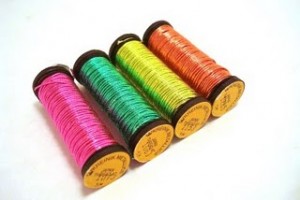
Are you confused by the colors in Kreinik’s metallics? Do you wish you could look at similar colors side-by-side? While shop owners, teachers and designers have color cards, most of us just get frustrated. Kreinik has come to our rescue with the new Color Selector Tool. It’s one of the best and most useful tools for stitchers on the internet. The site goes well beyond a color card. With it you can find all the shades in all the sizes of a particular color. If you want to know if a particular color comes in specific size of thread, enter the number, you’ll know immediately. The table includes product (size), number, name, shading order, and a photo of the thread. You can sort by any column, and more Those columns pack so much into them. You can buy threads from the table. You can see easily how the different finishes
Originally posted 2010-01-09 07:21:07. Republished by Blog Post Promoter Joce has made wonderful progress on her geometric project and has done two more posts. The Big V adds the large diamond surrounding the center. From a Diamond to Some Squares adds detail to the diamond and begins the corner squares. Inspired by a comment from Joce, Barbara at Create Needlepoint is starting a project called Needlepoint Stitch Tangle. It’s based on a kind of doodle called a Zentangle. A second post lists all the stitches she will be using and show the painted design. I really love it and am thinking (hard) about doing one or more of my own. I think I’m going to ask people in my family to make the doodle and then stitch one for each of them as an ornament. My DD also asked me about doing a set of three ornaments for a friend’s

The subtitle of this book is Interiors and Exteriors Plus and it packs so much into less than 75 pages. I’m just blown away by it. The majority of the chapters cover items you’ll find in buildings: bricks, fabrics, patios, floors, or more. Each chapter is formatted similarly. The first page is an introduction. It gives factors to consider when stitching this item. This is followed by additional explanation if needed. Finally several stitches in the chapter are highlighted with ideas for types and colors of thread to use. In the stitch diagrams themselves, exampled stitches are highlighted. While many of the stitches in this book are complex and are well-suited to using multiple threads, and even embellishments, there are tons of stitches that are simpler and work well with a single thread. What delights me about this book is how inventive it is. The authors have only a handful
Originally posted 2009-08-19 07:34:33. Republished by Blog Post Promoter I’m getting ready to start stitching a charming piece from Needle Delights called “Down the Garden Path.” I just love it and the way it uses so many different shades of Watercolurs. So I decided to use it as a chance to try some new colors of this and other overdyed threads, that were new to me. When I bought them I thought I could just switch one thread for another, but it isn’t quite so easy. The original threads have a range of values from light to dark, mine are mostly light. And they have a selection of multi-color threads and ones with shades of one color, I only have one or two single color threads. This happens to many stitchers, so I thought I would share with you how I have planned my threads out before I begin to

Personal Plaids, often called birthday plaids, use a name for the stripe sequence in one direction and a date for the sequence in the other direction. Why not use this technique to create a birthday plaid for the United States? To create a great design that could be a lovely boxtop, I added initials and put the whole thing into an outline of the US. Add a simple gold T Stitch background and you have a delightful project. To create this design you will need: 18-mesh mono white needlepoint canvas 9″ x 11″ 1 skein each your choice of thread in red, white and blue (I used Silk & Ivory) 1 spool Tapestry (#12) gold metallic thread 1 spool Fine (#8) gold metallic thread Pigma Micron (extra Fine tip) marker to trace outline gold marker suitable for fabric to trace letters Step-by-step Instructions Trace the outline (click to see full
Originally posted 2010-03-09 07:15:08. Republished by Blog Post Promoter Making the transition from stitching your first needlepoint sampler to doing canvases can be a hard one. The projects should be good-looking, appealing enough that even an experienced stitcher will want to stitch them. They should be small, so that the stitcher has a sense of accomplishment when it’s done. And they should always increase the stitcher’s needlepoint knowledge. Why is this important? Think about two different crafts, beading has been very successful at moving beginners to more complex projects, knitting has been less successful at this. With beading, people make that first necklace, bracelet, or pair of earrings and makes a bunch more. When ready for the next step there are many websites, more complex beads and lots of tutorials to let you make something lovely that is just a little bit harder but uses material you have used and